
Department of Law
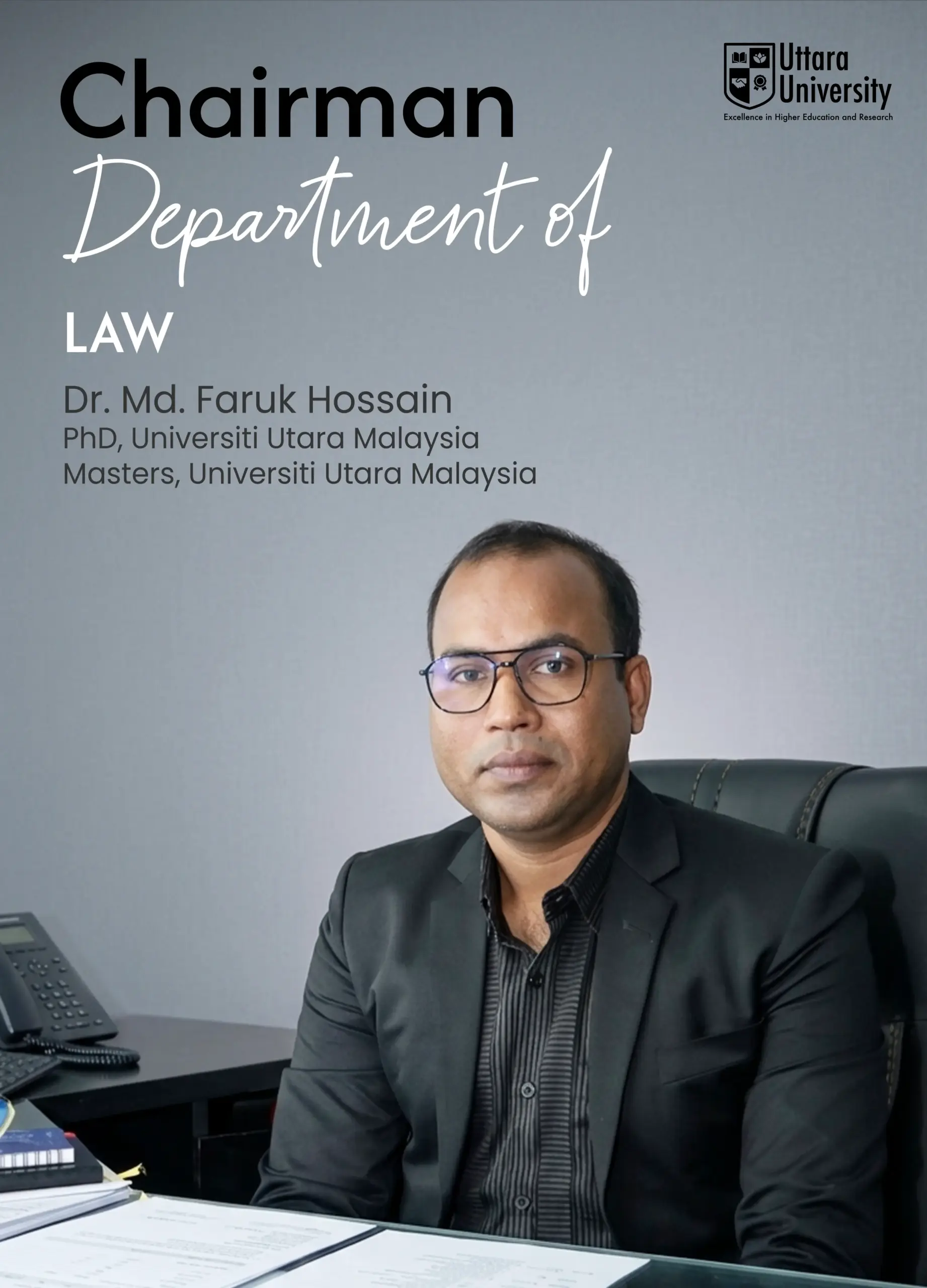
Chairman's Message
Welcome to the Department of Law. Uttara University Department of Law started its journey with a clear mission of contributing to nation-building through transformative and complete legal education. To impart quality legal education as per the needs of the changing world, the Department of Law has been making endeavors to well equip the students with both doctrinal knowledge and practical skills.
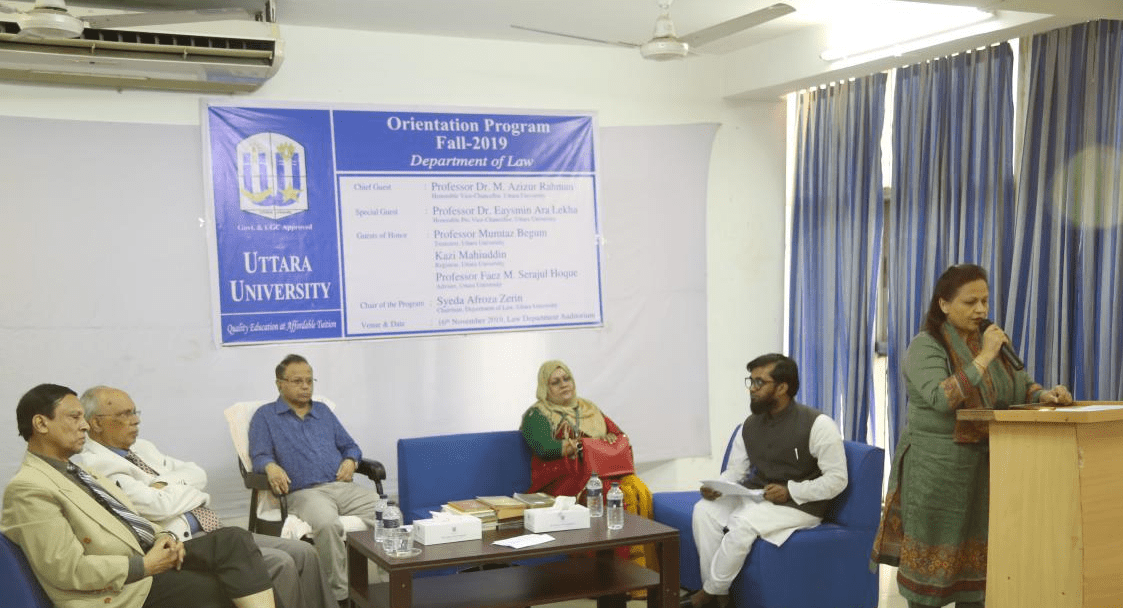
The motto of the Department of Law is ‘Learning by Serving’. Therefore, the curriculum of the Department of Law blends the academic rigors of the classroom with the real-life experience of contemporary society. Students are not only taught what the law is but also what the law ought to be. Our students have the opportunity to learn in a collegial and cooperative learning environment. Department of Law offers the opportunity to participate in participatory learning and interdisciplinary inquiry. Distinguished faculties are composed of academics, judges, practising lawyers, management experts and, economists and social scientists who possess academic excellence, practical skills and superior ability. Department of Law is committed to providing complete legal education beyond mere academic practices. Side by side with classroom training, teaching and learning includes, among others:
- Seminar, Webinar and Distinguished Law Lecture Series;
- Online Class with Foreign Faculties;
- Students’ Court Visit;
- Special Preparatory Training for Bar Council and Bangladesh Judicial Service Commission (BJSC) Examinations;
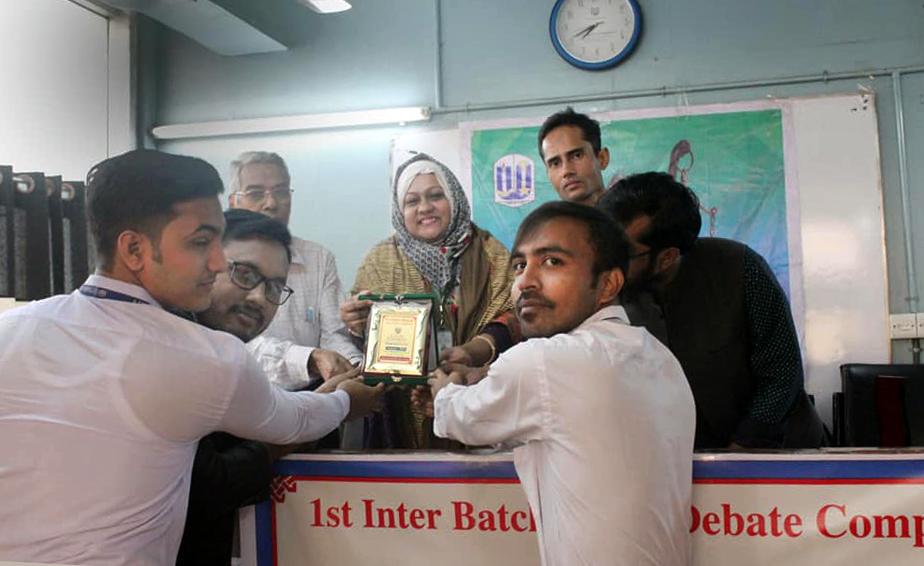
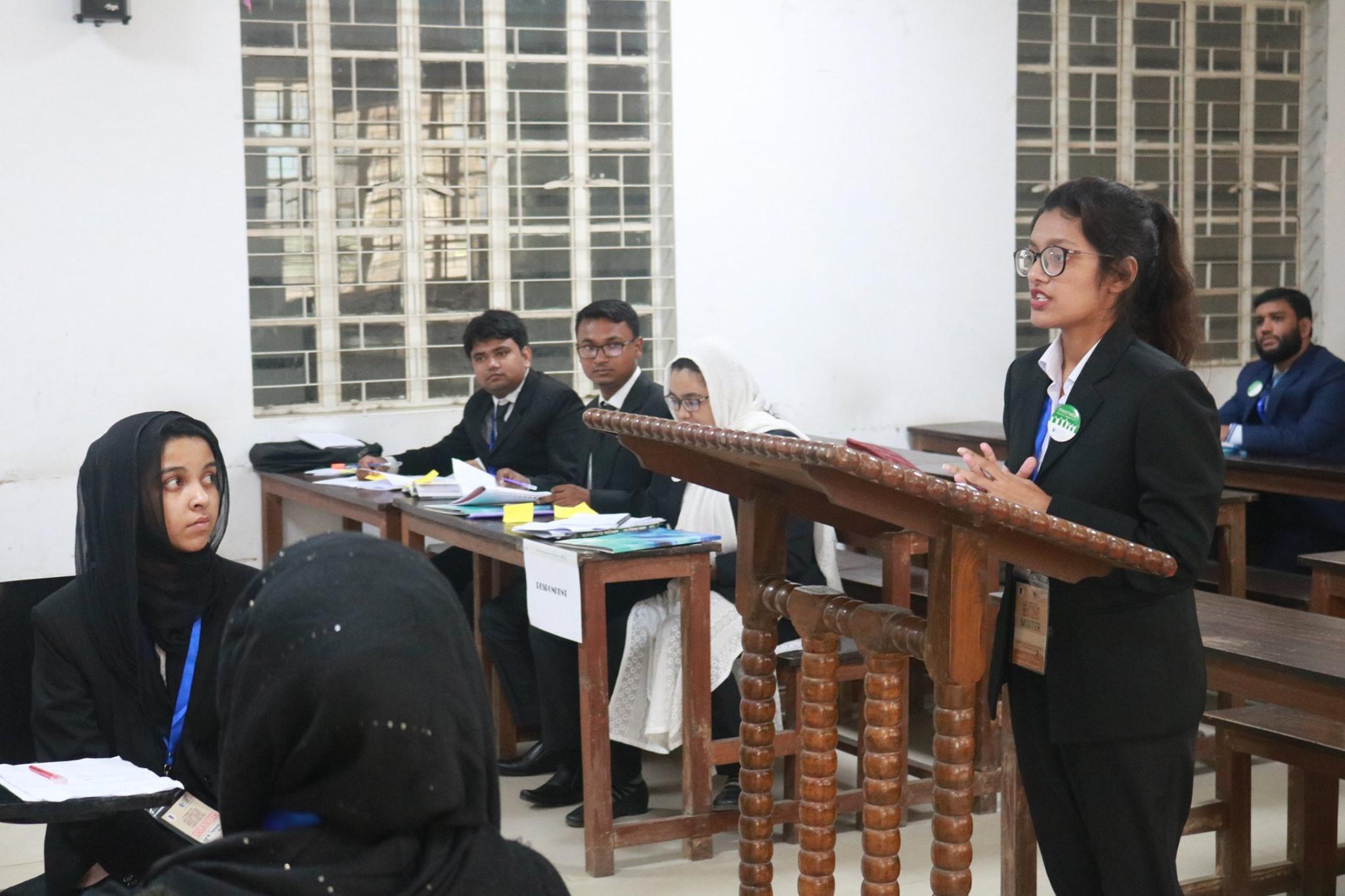
- Special Training for National and International Mooting and Debate Competition;
- Leadership Training through Co-Curricular and Socially Responsive Activities;
Dr. Md. Faruk Hossain
Assistant Professor and Chairman
Department of Law
To reach the Department of Law leadership via email, kindly email us at chair.law@uttara.ac.bd
Why Uttara University is One of the Top Universities for Law in Bangladesh?
Uttara University has earned a strong reputation as one of the leading private universities for LLB in Bangladesh by focusing on quality, accessibility, and real-world relevance. The Department of Law (UU Law) follows a student-centered approach that blends core legal theory with hands-on training, making the LLB course in Bangladesh both practical and intellectually engaging. With experienced faculty members drawn from academia and legal practice, students gain a solid foundation in key law subjects, clear guidance on LLB course duration, and a well-structured path toward completing a recognised LLB degree (Bachelor of Laws).
What truly sets Uttara University apart is its balance between academic excellence and affordability. With competitive LLB tuition fees, Merit based scholarships and transparent information on Uttara University LLB cost , it remains a preferred choice for students seeking a low-cost yet high-quality LLB. Focused preparation for Bar Council and judicial examinations, opportunities for mooting and debate, and strong support during LLB admission 2025 make Uttara University a confident answer to the question of which private university is best for LLB in Bangladesh, especially for those planning a serious and meaningful career in law.
Study Law at Uttara University and experience a journey where legal education shapes purpose, perspective and professional identity. At the Department of Law of Uttara University, learning is designed to inspire responsibility, sharpen judgment and cultivate a deep sense of justice .
Rooted in values and driven by inquiry, the department fosters an academic culture where students develop analytical depth, ethical clarity and confidence in legal reasoning. The experience goes beyond mastering statutes, it encourages students to think independently, engage thoughtfully with social realities, and prepare themselves for meaningful roles in the legal profession and public life.
For those seeking a legal education that is intellectually rigorous, socially conscious, and aligned with the demands of a changing world, studying law at Uttara University is the first step toward shaping the legal minds of tomorrow.
Department Overview
The Department of Law at Uttara University began its journey with a clear mission to contribute to nation-building through transformative and comprehensive legal education. Aiming to provide quality legal education that meets the needs of a changing world, the department focuses on equipping students with both doctrinal knowledge and practical skills. The department's motto, "Learning by Serving," reflects its approach of integrating academic rigor with real-life experience.
Students in the Department of Law are taught not only what the law is but also what the law should be. The curriculum is designed to blend classroom learning with practical experiences, fostering a collegial and cooperative learning environment. The department offers opportunities for participatory learning and interdisciplinary inquiry.
Our distinguished faculty members include academics, judges, practicing lawyers, management experts, economists, and social scientists, all of whom bring academic excellence, practical skills, and superior expertise to the classroom. The Department of Law is committed to providing a complete legal education that extends beyond mere academic practice.
Vision and Mission
The Department of Law aspires to be a center of excellence in legal education, aligned with global standards. Our vision includes producing graduates with high-quality legal skills to address the needs of both the nation and society, fostering high-caliber research, and establishing national and international collaborations with stakeholders in our academic programs.
To achieve this vision, our missions are:
- Conduct Legal Education Programs: To produce well-educated and trained graduates with competitive quality and skills in related fields.
- Utilize Effective Teaching and Learning Strategies: Combining theoretical and practical exercises, fieldwork, and legal apprenticeship to enhance learning outcomes.
Develop Problem-Solving Skills: Equip students with the skills and motivation to address complex and emerging societal issues under the law.
Promote Relevant Research: Focus on areas that have a transformative impact on society, contributing to peace and development both nationally and internationally.
Organize Important Programs: Conduct, arrange, or sponsor significant programs in the field of law, individually and in collaboration with reputable institutions, organizations, and entities.
What expertise do we build up?
- Create Lawyers with a Deep Understanding of Law: Develop legal professionals who grasp the nature of law, its role in various spheres of human life, and its mechanisms for creating an orderly society. Ensure they are introduced to up-to-date global knowledge in relevant fields
- Cultivate Essential Legal Attributes: Foster the qualities expected of top-tier legal professionals, including the ability to handle practical issues effectively. Emphasize the use of modern scientific techniques and digitization in the legal field.
- Produce Well-Trained and Values-Driven Professionals: Train graduates to possess strong personal values and social motivation. Ensure they are responsive to societal needs, apply innovative techniques for improved legal practice, and address gaps in the existing system.
- Develop Research and Leadership Capacities: Equip students with the skills to conduct impactful research, guide policy and work plans, and exhibit leadership qualities that drive transformative societal change.
Objectives
The objectives of the Department of Law are:
- To be a Center of High-Quality Legal Education and Research: Establish the department as a leading institution for exceptional legal education and research.
- To Produce Capable Graduates: Develop students who embody the core values of justice, the rule of law, professional ethics, and social responsibility.
- To Train Highly Skilled Legal Professionals: Prepare graduates to excel in various sectors, including the judiciary, legal practice, human rights advocacy, and legal services in commercial, economic, industrial, investment, national, and international contexts.
Medium of Instruction
Uttara University offers all the courses of study primarily in English. Teachers provide instruction to students in the classroom in English. English is also widely used as a medium of communication among the faculties, students, and administrative officials.
Academic Programs
Graduate
1. Master of Laws (LLM)
Undergraduate
1. Bachelor of Laws (LLB (Hons))
Program Overview
Bachelor of Laws (LLB (Hons))
The LLB (Hons) program is a 4-year program comprising two semesters in each year—Spring (January-June) and Fall (July-December). The program includes an educational plan combining conceptual, research, and practical study modules with courses covering major areas of legal studies, professional needs, multidisciplinary knowledge, and practical work. The courses are designed to address practical field needs, generate high skills, and provide a sound legal basis, which students will develop with modern advancements. The theoretical knowledge of the program is accompanied by practical implementation courses such as trials, legal profession drafting, debating, and participation in national and international legal competitions. The educational plan aims to produce properly trained, skilled, and motivated legal professionals to serve in various fields of legal services and other general fields.
For the LLB (Hons) degree, a student needs to complete a total of 150 credit hours, which include General Education Courses (GED), Core Legal Courses, other legal concentration courses, legal research methodology, and viva-voce presentation courses. The GED courses (39 credits) are designed to raise the general education level in a multidisciplinary context and include courses such as Language and Communicative Skill Development, Computer and IT Skills, Social and Political Studies, Criminal Investigative Studies, and other GED courses in the Humanities and Culture group. The remaining courses (equivalent to 111 credits) cover various aspects of legal skills. Students must pass all courses individually and maintain a minimum CGPA of 2.0.
Graduate Attributes
Graduate attributes which are aspired to be generated among students through this curriculum are shown in the following three categories:
Table 1: Knowledge Profile
| Attributes | |
|---|---|
| K1 | Knowledge about the functional mechanism of law, rights, duties and obligations, legal control of social order, norms of exercising administrative power and theories or principles on limits on power, legal check and judicial review of administrative power, and relation of law with society. |
| K2 | Knowledge about institutional mechanisms of serving justice. |
| K3 | Knowledge of investigative and trial mechanisms and dispute settlement systems. |
| K4 | Knowledge of different branches of law pertaining to civil and criminal proceedings; corporate and commercial legal matters; industrial and labor law; taxation law; judicial review of executive actions; and criminal justice, among other issues. |
| K5 | Knowledge pertaining to practical case solving, sorting and organizing essential facts in a case, conducting trials, connecting evidence to the issues of the case, and using scientific evidence analysis. |
| K6 | Knowledge of different types of legal drafting and legal compliance in various important matters, including those related to individuals, commercial transactions, and government administrative necessities. |
| K7 | Knowledge about legal research methodology. |
Table 2: Applied Skills
| Attributes | Applied Areas |
|---|---|
| Legal Interpretative Skill of Statutes (K1 and K4 required) | Analyze the text of statutes, understand the factual elements required for applying the text of a statute,
identify errors that may affect the legality of its application, and understand and guide the standards of proof required for
applying particular laws or making decisions. Provide guidance on selecting and implementing legal remedies for erroneous
applications of the law. Provide guidance on legal steps for compliance, assist the court in dispensing justice with such analysis, and offer legal documentation services to ensure compliance with the law. |
| Selection of forum or institutional mechanism for legal remedy (K2 required) | There are various institutional mechanisms for dispensing justice in different types of cases and remedies. Selecting the appropriate forum is a prerequisite for resolving disputes and determining the type of remedy required in a particular case. |
| Trial conducting, investigative fact-finding skill (Combined knowledge K3 and K5 required) | Conducting trials, investigative fact-finding, sorting the facts in a case, using scientific methods to analyze evidence, and connecting evidence to central issues for judicial decision-making. |
| Carrying out legal functions in different areas. (K4 and K6 required) | Graduates will be able to take legal steps in civil and criminal proceedings, handle corporate and commercial
legal matters, apply industrial and labor laws, taxation law, and provide guidance on judicial review of executive actions, criminal
treatment, and other relevant issues. They can perform various types of legal drafting and ensure legal compliance in important matters related to individuals, commercial entities, and government administrative needs. |
| Conducting Legal Research (K7 required) | Students will be able to conduct legal research to address societal and governmental needs, inform decision-making and legislation, and contribute to improving the existing legal system. |
Program Educational Objectives (PEOs)
The objectives of the LLB (Hons) program are to produce graduates who are skilled performers in their respective fields, judgment-driven, responsive to real-world needs, practical, and capable of both individual and collaborative decision-making, while remaining committed to professional ideals. Upon graduation, successful graduates will have the following attributes:
| PEO1 | Understand the nature of law, its role in various aspects of human life, its contribution to establishing an orderly society, and its value in pursuing the objectives of human life within the community. |
| PEO2 | Possess the professional qualities expected of highly skilled lawyers to effectively address various practical issues in the field. |
| PEO3 | Be responsive to societal needs, enhance the effectiveness of professional duties, and address ongoing deficiencies in the existing system. |
| PEO4 | Serve society with the values and ideals expected of educated professionals. |
| PEO5 | Conduct research to create transformative impacts on society and address contemporary social needs. |
Program Learning Outcomes (PLOs)
To prepare students for a successful professional and personal life, the LLB (Hons) program is designed to enable graduates to attain the following learning outcomes:
**PLO1:** Acquire knowledge and understanding of different branches of law, the functional mechanisms of law, and its interpretive methods for application in related fields, along with knowledge of allied matters to foster multidisciplinary thinking.
**PLO2:** Develop professional skills to become confident performers in the legal profession, including the ability to identify and resolve components of problems in practical cases, simplify complex issues, provide judicious legal treatments, and work with clarity, neatness, and reasoning.
**PLO3:** Demonstrate leadership qualities to contribute to societal well-being, national and global interests, and excel in the legal profession with comprehensive knowledge and critical thinking.
**PLO4:** Cultivate values through the academic learning process that emphasize serving human society with ideals of justice, the rule of law, democracy, human rights, professional ethics, the constitutional spirit of Bangladesh, nationalism, and cultural traditions.
**PLO5:** Acquire the necessary skills and motivation to conduct research that has a transformative impact on society, fostering development and peace, establishing justice, enhancing the rule of law, and better securing the rights of people at both national and global levels.
Mapping of Missions of Program Offering Entity with University Missions
| Law Dept. Missions | UU Mission 1 | UU Mission 2 | UU Mission 3 |
|---|---|---|---|
| Dept. Mission 1 | √ | √ | |
| Dept. Mission 2 | √ | √ | √ |
| Dept. Mission 3 | √ | √ | |
| Dept. Mission 4 | √ | √ | |
| Dept. Mission 5 | √ | √ |
Mapping of PEOs with Missions of Program Offering Entity
| PEOs | Dept. Mission 1 | Dept. Mission 2 | Dept. Mission 3 | Dept. Mission 4 | Dept. Mission 5 |
|---|---|---|---|---|---|
| PEO1 | √ | √ | √ | ||
| PEO2 | √ | √ | |||
| PEO3 | √ | √ | |||
| PEO4 | √ | √ | |||
| PEO5 | √ | √ | √ | √ | √ |
Mapping PLOs with PEOs
| PLOs | PEO-1 | PEO-2 | PEO-3 | PEO-4 | PEO-5 |
|---|---|---|---|---|---|
| PLO-1 | √ | √ | |||
| PLO-2 | √ | √ | √ | ||
| PLO-3 | √ | √ | √ | ||
| PLO-4 | √ | ||||
| PLO-55 | √ | √ | √ | √ | √ |
Mapping courses with the PLOs
| Title | Details |
|---|---|
| Mapping courses with the PLOs | View |
Master of Laws (LLM) 1 Year Program
Description of the Program
The LLM 1-Year program is divided into two semesters: Spring (January-June) and Fall (July-December). Students are required to complete a 40-credit education plan that combines conceptual, research, and practical study modules with courses focusing on major areas of legal studies, professional needs, multidisciplinary knowledge, and practical work. At the end of each semester, students must take a viva voce test before a Viva Board to demonstrate their acquired knowledge and skills throughout the semester.
Program Educational Objectives (PEOs):
The objectives of the LLM program are to provide comparative and in-depth legal knowledge, research and analytical abilities, skills, and wisdom for effective service in the legal field. This program is designed to produce a well-educated generation capable of addressing various areas, including civil and criminal justice, maintaining law and order in society, handling legal issues in commerce and investment, dispute resolution, industrial and environmental matters, national and international legal issues, and conducting research.
| PEO1 | Analyze the law by delving deeply into the subject matter, being mindful of conceptual dynamism through a comparative perspective, and developing multidisciplinary competence and thinking skills. |
| PEO2 | Exhibit the legal professional qualities expected of highly esteemed lawyers to effectively address various practical challenges. |
| PEO3 | Respond to societal needs, improve the quality of professional service, and address ongoing shortcomings in the existing system. |
| PEO4 | Serve society with the high values and ideals expected by various educated groups within the community. |
| PEO5 | Conduct research to drive transformative societal impact towards development and peace and to establish justice and the rule of law. |
Program Learning Outcomes (PLOs)
To prepare students for a successful professional and personal life, the LLM 1-Year program is designed to enable graduates to achieve the following learning outcomes through the academic education process:
**PLO1:** Acquire knowledge in various branches of law and related fields in an analytical manner, stay aligned with conceptual shifts, and gain insights into societal, national, international, and practical matters from a multidisciplinary perspective.
**PLO2:** Develop professional skills to become confident practitioners in the legal profession, address different components of practical problems, untangle complexities, find effective and simple solutions, apply judicious legal treatments, and work with professional neatness, clarity, and reasoning.
**PLO3:** Cultivate leadership qualities to contribute effectively to society, promote the general well-being of people, and advance national and global interests, while being well-versed in legal knowledge and thinking.
**PLO4:** Embody values through the academic learning process by serving human society with ideals of justice, rule of law, democracy, human rights, professional ethics, and the constitutional spirit of Bangladesh, nationalism, and cultural traditions.
**PLO5:** Develop the skills necessary for conducting research and be motivated to create transformative impacts on society, promoting development and peace, establishing justice and the rule of law, and safeguarding the rights of individuals at both national and global levels.
Mapping of the Missions of the Program Offering Entity with University Missions
| Law Dept. Missions | UU Mission 1 | UU Mission 2 | UU Mission 3 |
|---|---|---|---|
| Dept. Mission 1 | √ | √ | |
| Dept. Mission 2 | √ | √ | √ |
| Dept. Mission 3 | √ | √ | |
| Dept. Mission 4 | √ | √ | |
| Dept. Mission 5 | √ | √ |
Mapping of PEOs with Missions of Program Offering Entity
| PEOs | Dept. Mission 1 | Dept. Mission 2 | Dept. Mission 3 | Dept. Mission 4 | Dept. Mission 5 |
|---|---|---|---|---|---|
| PEO1 | √ | √ | √ | ||
| PEO2 | √ | √ | |||
| PEO3 | √ | √ | |||
| PEO4 | √ | √ | |||
| PEO5 | √ | √ | √ | √ | √ |
Mapping PLOs with PEOs
| PLOs | PEO-1 | PEO-2 | PEO-3 | PEO-4 | PEO-5 |
|---|---|---|---|---|---|
| PLO-1 | √ | √ | √ | ||
| PLO-2 | √ | √ | √ | √ | |
| PLO-3 | √ | √ | √ | ||
| PLO-4 | √ | √ | |||
| PLO-55 | √ | √ | √ | √ | √ |
Mapping courses with the PLOs
| Title | Details |
|---|---|
| Mapping courses with the PLOs | View |
Guideline For Student
Marks Distribution
| Particulars | Marks |
|---|---|
| Class Attendance + Class Performance | 5% |
| Class Test + Assignment | 10% |
| Mid Term Examination | 25% |
| Semester Final Examination | 50% |
| Viva Voce | 10% |
| Total | 100% |
Admission Requirements (Undergraduate)
Bachelor of Laws (LLB Honours)
Structure of the Curriculum
a) Duration of the program: 04 years divided into 08 semesters
b) Admission Requirements: Students can be admitted to the LLB (Hons.) program if they have obtained a minimum GPA of 2.50 at both the SSC and HSC levels separately, or a total of 6.0 points in both cases with a minimum of 2.0 in one level, as per UGC rules. An admission test is arranged by the School/Department or the university, covering criteria such as Language & Communication, General Knowledge, Analytical Ability, Knowledge in National and International Affairs, IQ, etc.
Students who have completed their education in foreign countries are also required to meet the same academic standards for admission. Their academic transcripts must be accepted by the Department as equivalent to the aforementioned standards.
c) Total Class Weeks in a semester/year: 14 weeks in a semester, or 28 weeks in a year.
d) Minimum CGPA requirements for graduation: CGPA 2.0
e) Maximum Academic Year of Completion: 4+3= 7 Years
Admission Requirements (Graduate)
Master of Laws (LLM) 1 year program
Structure of the Curriculum
a) Duration of the program: 1 year divided into 2 semesters
b) Admission Requirements: Students must have completed an LLB (Hons) 4-year program from a recognized university, with at least a 2nd class or a minimum CGPA of 2.50.
An admission test is conducted by the School/Department or the university. The test criteria include knowledge of core LLB (Hons) courses, language and communication skills, general knowledge, analytical ability, awareness of national and international affairs, and IQ.
Students who have graduated from foreign institutions must meet the same academic standards for admission. Their academic transcripts will be reviewed by the Department to ensure equivalency with the aforementioned requirements.
c) Total Class Weeks in a Semester/Year: 14 weeks in a semester or 28 weeks in a year.
d) Minimum CGPA requirements for LLM Program: CGPA 2.0
e) Maximum Academic Year of Completion: 1+2= 3 Years
f) Category of Courses: The courses of the LLM 1year program fall under the following categories:
i) Compulsory Interdisciplinary or General Education (GED) Courses: 2 GED courses, each course bearing 3 credits. Total credits: 6.
ii) Core Courses: The program includes 10 core courses, each carrying 3 credits, for a total of 30 credits. These core courses consist of both general taught courses and research-oriented courses. Students are required to select courses from those offered by the department. Those wishing to enroll in the "Research Monograph" course must first complete the specified research skill development courses.
iii) Viva: In the LLM 1-Year program, students are required to attend a viva voce test at the end of each semester. Therefore, they must complete two viva voce tests throughout the program, each carrying 2 credits, for a total of 4 credits.
Courses of LLB (Hons) Program
Course Structure
General Education Development (GED) Courses (39 Credits Collectively)
(Student will take any 13 courses offered by the Department from the following list)
| Language and Communicative Skill Development | ||
|---|---|---|
| SL No | Course Code & No. | Course Title |
| 1. | GED0011114 | English For Law |
| 2. | GED0232115 | Communicative English |
| 3. | GED0232126 | (Compulsory GED Course) |
| Computer Skill | ||
|---|---|---|
| SL No | Course Code & No. | Course Title |
| 1. | GED0611125 | Introduction to Computer and IT |
| Social and Political Studies | ||
|---|---|---|
| SL No | Course Code & No. | Course Title |
| 1. | GED0314113 | Law and Society |
| 2. | GED0312124 | Government and Politics |
| 3. | GED0311226 | Law and Economics |
| 4. | GED0312316 | International Relations |
| 5. | GED05424111 | Introduction to Statistics |
| 6. | GED0031419 | Sociology of Law |
| 7. | GED03114110 | Economics: Basic Concepts |
| 8. | GED0413425 | Project Management |
| Humanities and Culture | ||
|---|---|---|
| SL No | Course Code & No. | Course Title |
| 1. | GED0222116 | Bangladesh Studies (Compulsory GED Course) |
| 2. | GED0222215 | History of Emergence of Bangladesh (Compulsory GED Course) |
| 3. | GED0421428 | Logic and Legal Reasoning |
| Criminal Investigative Studies | ||
|---|---|---|
| SL No | Course Code & No. | Course Title |
| 1. | GED0031416 | Forensic Science and Scientific Evidence |
Core Legal Courses (87 Credits Collectively)
| Title | Details |
|---|---|
| Core Legal Courses | View |
Concentration Courses (Total 18 credits)
(Student will take any 6 courses offered by the Department from the following list)
| SL No | Course Code & No. | Course Title |
|---|---|---|
| 1. | LLB0421212 | Law of Anti-Corruption, Anti-Money Laundering, and Combatting Terrorism |
| 2. | LLB0421216 | Fundamentals of Human Rights |
| 3. | LLB0421321 | Legal Research Methodologies |
| 4. | LLB0421327 | Cyber and e-Communication Law |
| 5. | LLB0421328 | Environmental Law |
| 6. | LLB0421412 | Law of Taxation |
| 7. | LLB0421414 | Contract Drafting |
| 8. | LLB0421417 | Penology and Victimology |
| 9. | LLB0421418 | Banking and Securities Laws |
| 10. | LLB0421421 | Media and Tele-Communication Law |
| 11. | LLB0421426 | Corporate Governance |
| 12. | LLB0421427 | Internship |
Viva-Voce (6 Credits Collectively)
| 1. | LLB0421127 | Viva-Voce | At First Year Second Semester |
| 2. | LLB0421227 | Viva-Voce | At Second Year Second Semester |
| 3. | LLB0421329 | Viva-Voce | At Third Year Second Semester |
| 4. | LLB0421429 | Viva-Voce | At Fourth Year Second Semester |
Course Structure of Master of Laws (LLM): 1 Year Program
Categories of courses in summary
The undergraduate courses in the Department of Law are grouped into following 4 categories:
| 1. | General Education Development (GED) Courses | 6 Credits |
| 2. | Core Legal Courses (including general taught and research courses) | 30 Credits |
| 3. | Two Viva Voce tests | 4 Credits |
| Total Credits | 40 Credits | |
Total Number of Courses and Credits:
In the LLM 1-Year program, students are required to complete 12 courses totaling 40 credits, which includes the viva voce tests.
Distribution of courses the LLM-1 Year Program
General Education Development (GED) Courses (6 Credits Collectively)
(Student will take 2 courses offered by the Department from the following list)
| SL No | Course Code & No. | Course Title |
|---|---|---|
| 1. | GED03126108 | Good Governance Principles and Practice |
| 2. | GED03126208 | Principles of Political System |
| 3. | GED042162012 | Changing Concepts of Justice |
Core Legal Courses (including general taught courses and research courses) (30 Credits Collectively)
(Students will select any 10 courses offered by the Department from the following list)
| Title | Details |
|---|---|
| Core Legal Courses | View |
Viva-Voce (4 Credits Collectively)
| 1. | LLM042161016 | Viva-Voce | At First Semester |
| 2. | LLM042162013 | Viva-Voce | At Second Semester |
Department of Law Co-Curricular Clubs List
- Uttara University Moot Court Society
- Uttara University Law Society
Departmental Committees
Academic & Curriculum Committee
| SL No. | Name and Designation | Responsibility |
|---|---|---|
| 1 | Dr. Md. Faruk Hossain, Assistant Professor | Chairman |
| 2 | Dr. Syeda Afroza Zerin, Professor | Convener |
| 3 | Dr. Md. Omar Faruque Munshi, Associate Professor | Member |
| 4 | Dr. Mafruza Sultana, Assistant Professor | Member |
| 5 | Md. Naimul Hasan, Assistant Professor | Member |
Examination & Assessment Committee
| SL No. | Name and Designation | Responsibility |
|---|---|---|
| 1 | Dr. Md. Faruk Hossain, Assistant professor | Chairman |
| 2 | Md. Naimul Hasan, Assistant Professor | Convener |
| 3 | Ali Akbar Angan, Lecturer | Member |
| 4 | Asaduzzaman Sohag, Lecturer | Member |
Exam Question Moderation Committee
| SL No. | Name and Designation | Responsibility |
|---|---|---|
| 1 | Md. Naimul Hasan, Assistant Professor | Convener |
| 2 | Dr. Syeda Afroza Zerin, Professor | Member |
| 3 | Dr. Md. Omar Faruque Munshi, Associate Professor | Member |
| 4 | Dr. Md. Faruk Hossain, Assistant Professor | Member |
| 5 | Dr. Mafruza Sultana, Assistant Professor | Member |
Examination Committee
| SL No. | Name and Designation | Responsibility |
|---|---|---|
| 1 | Md. Naimul Hasan, Assistant Professor | Convener |
| 2 | Asaduzzaman Sohag, Lecturer | Member |
| 3 | Ali Akbar Angan, Lecturer | Member |
| 4 | Kalyan Chakroborty, Lecturer | Member |
| 5 | Tasmia Nur Washaka, Lecturer | Member |
| 6 | Saima Sultana, Lecturer | Member |
Invigilation and Supervision committee
| SL No. | Name and Designation | Responsibility |
|---|---|---|
| 1 | Dr. Syeda Afroza Zerin, Professor | Convener |
| 2 | Dr. Md. Omar Faruque Munshi, Associate Professor | Member |
| 3 | Dr. Md. Faruk Hossain, Assistant Professor | Member |
Research & Scholarly Activities Committee
| SL No. | Name and Designation | Responsibility |
|---|---|---|
| 1 | Dr. Md. Faruk Hossain, Assistant Professor | Chairman |
| 2 | Dr. Syeda Afroza Zerin, Professor | Convener |
| 3 | Dr. Md. Omar Faruque Munshi, Associate Professor | Member |
| 4 | Rabeya Dewan, Lecturer | Member |
| 5 | Kalyan Chakroborty, Lecturer | Member |
| 6 | Tasmia Nur Washaka, Lecturer | Member |
| 7 | Saima Sultana, Lecturer | Member |
Student Affairs, Academic Advising & Progress Committee
| SL No. | Name and Designation | Responsibility |
|---|---|---|
| 1 | Dr. Md. Faruk Hossain, Assistant Professor | Chairman |
| 2 | Dr. Mafruza Sultana, Assistant Professor | Convener |
| 3 | Ali Akbar Angan, Lecturer | Member |
| 4 | Asaduzzaman Sohag, Lecturer | Member |
| 5 | Rabeya Dewan, Lecturer | Member |
| 6 | Tasnova Tabassum, Lecturer | Member |
Student Grievance, Discipline & Academic Integrity Committee
| SL No. | Name and Designation | Responsibility |
|---|---|---|
| 1 | Dr. Md. Faruk Hossain, Assistant Professor | Chairman |
| 2 | Dr. Md. Omar Faruque Munshi, Associate Professor | Convener |
| 3 | Jayasri Samaddar, Associate Professor | Member |
| 4 | Rabeya Dewan, Lecturer | Member |
| 5 | Kalyan Chakroborty, Lecturer | Member |
| 6 | Tasnova Tabassum, Lecturer | Member |
Alumni, Employer & Professional Stakeholder Engagement Committee
| SL No. | Name and Designation | Responsibility |
|---|---|---|
| 1 | Dr. Md. Faruk Hossain, Assistant Professor | Chairman |
| 2 | Dr. Md. Omar Faruque Munshi, Associate Professor | Convener |
| 3 | Md. Naimul Hasan, Assistant Professor | Member |
| 4 | Ali Akbar Angan, Lecturer | Member |
| 5 | Asaduzzaman Sohag, Lecturer | Member |
| 6 | Kalyan Chakroborty, Lecturer | Member |
Program Self-Assessment Committee (PSAC)
| SL No. | Name and Designation | Responsibility |
|---|---|---|
| 1 | Dr. Md. Faruk Hossain, Assistant Professor | Chairman |
| 2 | Dr. Syeda Afroza Zerin, Professor | Convener |
| 3 | Dr. Md. Omar Faruque Munshi, Associate Professor | Member |
PSAC Sub-Committees
Governance & Institutional Integrity Sub-Committee
| SL No. | Name and Designation | Responsibility |
|---|---|---|
| 1 | Dr. Syeda Afroza Zerin, Professor | Convener |
| 2 | Dr. Md. Omar Faruque Munshi, Associate Professor | Member |
| 3 | Dr. Md. Faruk Hossain, Assistant Professor | Member |
Curriculum & OBE Sub-Committee
| SL No. | Name and Designation | Responsibility |
|---|---|---|
| 1 | Dr. Syeda Afroza Zerin, Professor | Convener |
| 2 | Dr. Md. Omar Faruque Munshi, Associate Professor | Member |
| 3 | Dr. Md. Faruk Hossain, Assistant Professor | Member |
| 4 | Dr. Mafruza Sultana, Assistant Professor | Member |
| 5 | Md. Naimul Hasan, Assistant Professor | Member |
Teaching-Learning & Assessment Sub-Committee
| SL No. | Name and Designation | Responsibility |
|---|---|---|
| 1 | Dr. Syeda Afroza Zerin, Professor | Convener |
| 2 | Dr. Md. Omar Faruque Munshi, Associate Professor | Member |
| 3 | Dr. Md. Faruk Hossain, Assistant Professor | Member |
| 4 | Dr. Mafruza Sultana, Assistant Professor | Member |
| 5 | Md. Naimul Hasan, Assistant Professor | Member |
Student Support & Progress Sub-Committee
| SL No. | Name and Designation | Responsibility |
|---|---|---|
| 1 | Asaduzzaman Sohag, Lecturer | Convener |
| 2 | Ali Akbar Angan, Lecturer | Member |
| 3 | Rabeya Dewan, Lecturer | Member |
| 4 | Kalyan Chakroborty, Lecturer | Member |
| 5 | Tasnova Tabassum, Lecturer | Member |
Faculty & Professional Development Sub-Committee
| SL No. | Name and Designation | Responsibility |
|---|---|---|
| 1 | Dr. Syeda Afroza Zerin, Professor | Convener |
| 2 | Dr. Md. Omar Faruque Munshi, Associate Professor | Member |
| 3 | Jayasri Samaddar, Associate Professor | Member |
| 4 | Dr. Md. Faruk Hossain, Assistant Professor | Member |
| 5 | Dr. Mafruza Sultana, Assistant Professor | Member |
| 6 | Md. Naimul Hasan, Assistant Professor | Member |
Facilities, Library & ICT Sub-Committee
| SL No. | Name and Designation | Responsibility |
|---|---|---|
| 1 | Rabeya Dewan, Lecturer | Convener |
| 2 | Kalyan Chakroborty, Lecturer | Member |
| 3 | Tasnova Tabassum, Lecturer | Member |
| 4 | Tasmia Nur Washaka, Lecturer | Member |
| 5 | Saima Sultana, Lecturer | Member |
Research & Scholarly Activities Sub-Committee
| SL No. | Name and Designation | Responsibility |
|---|---|---|
| 1 | Dr. Syeda Afroza Zerin, Professor | Convener |
| 2 | Dr. Md. Omar Faruque Munshi, Associate Professor | Member |
| 3 | Jayasri Samaddar, Associate Professor | Member |
| 4 | Dr. Md. Faruk Hossain, Assistant Professor | Member |
| 5 | Dr. Mafruza Sultana, Assistant Professor | Member |
| 6 | Md. Naimul Hasan, Assistant Professor | Member |
Alumni, Employer & Stakeholder Feedback Sub-Committee
| SL No. | Name and Designation | Responsibility |
|---|---|---|
| 1 | Ali Akbar Angan, Lecturer | Convener |
| 2 | Asaduzzaman Sohag, Lecturer | Member |
| 3 | Rabeya Dewan, Lecturer | Member |
| 4 | Kalyan Chakroborty, Lecturer | Member |
| 5 | Tasnova Tabassum, Lecturer | Member |
Documentation & Evidence Sub-Committee
| SL No. | Name and Designation | Responsibility |
|---|---|---|
| 1 | Ali Akbar Angan, Lecturer | Convener |
| 2 | Asaduzzaman Sohag, Lecturer | Member |
| 3 | Kalyan Chakroborty, Lecturer | Member |
| 4 | Tasmia Nur Washaka, Lecturer | Member |
| 5 | Saima Sultana, Lecturer | Member |
Monitoring, Evaluation & Improvement Sub-Committee
| SL No. | Name and Designation | Responsibility |
|---|---|---|
| 1 | Dr. Syeda Afroza Zerin, Professor | Convener |
| 2 | Dr. Md. Omar Faruque Munshi, Associate Professor | Member |
| 3 | Dr. Md. Faruk Hossain, Assistant Professor | Member |
Course Allocation and Class Routine Committee
| SL No. | Name and Designation | Responsibility |
|---|---|---|
| 1 | Dr. Md. Faruk Hossain, Assistant Professor | Convener |
| 2 | Asaduszaman Sohag, Lecturer | Member |
| 3 | Ali Akbar Angan, Lecturer | Member |
Departmental Co-curricular Committee
| SL No. | Name and Designation | Responsibility |
|---|---|---|
| 1 | Dr. Md. Faruk Hossain, Assistant Professor | Chairman |
| 2 | Rabeya Dewan, Lecturer | Convener |
| 3 | Kalyan Chakroborty, Lecturer | Member |
| 4 | Tasnova Tabassum, Lecturer | Member |
| 5 | Tasmia Nur Washaka, Lecturer | Member |
| 6 | Saima Sultana, Lecturer | Member |
Admission and Outreach Committee
| SL No. | Name and Designation | Responsibility |
|---|---|---|
| 1 | Dr. Md. Faruk Hossain, Assistant Professor | Chairman |
| 2 | Kalyan Chakroborty, Lecturer | Convener |
| 3 | Niamur Rakib, Lecturer | Member |
Staff of the Department of Law

Md. Atiqur Rahman
Senior Section Officer
MSc, National University
BSc, National University
md.atiqurrahman@uttarauniversity.edu.bd
View ProfileContact and Location
Visit Us : Holding 77, Beribadh Road, Turag, Uttara, Dhaka 1230, Bangladesh
Mobile : 01872607360-69
E-mail : info@uttarauniversity.edu.bd
Loading...